How I Use AI to Run a Startup Alongside a Full-Time Job
The systems that let two people run a physical-product brand in the hours around demanding careers.
By Julia Raciniewska · · 3 min read
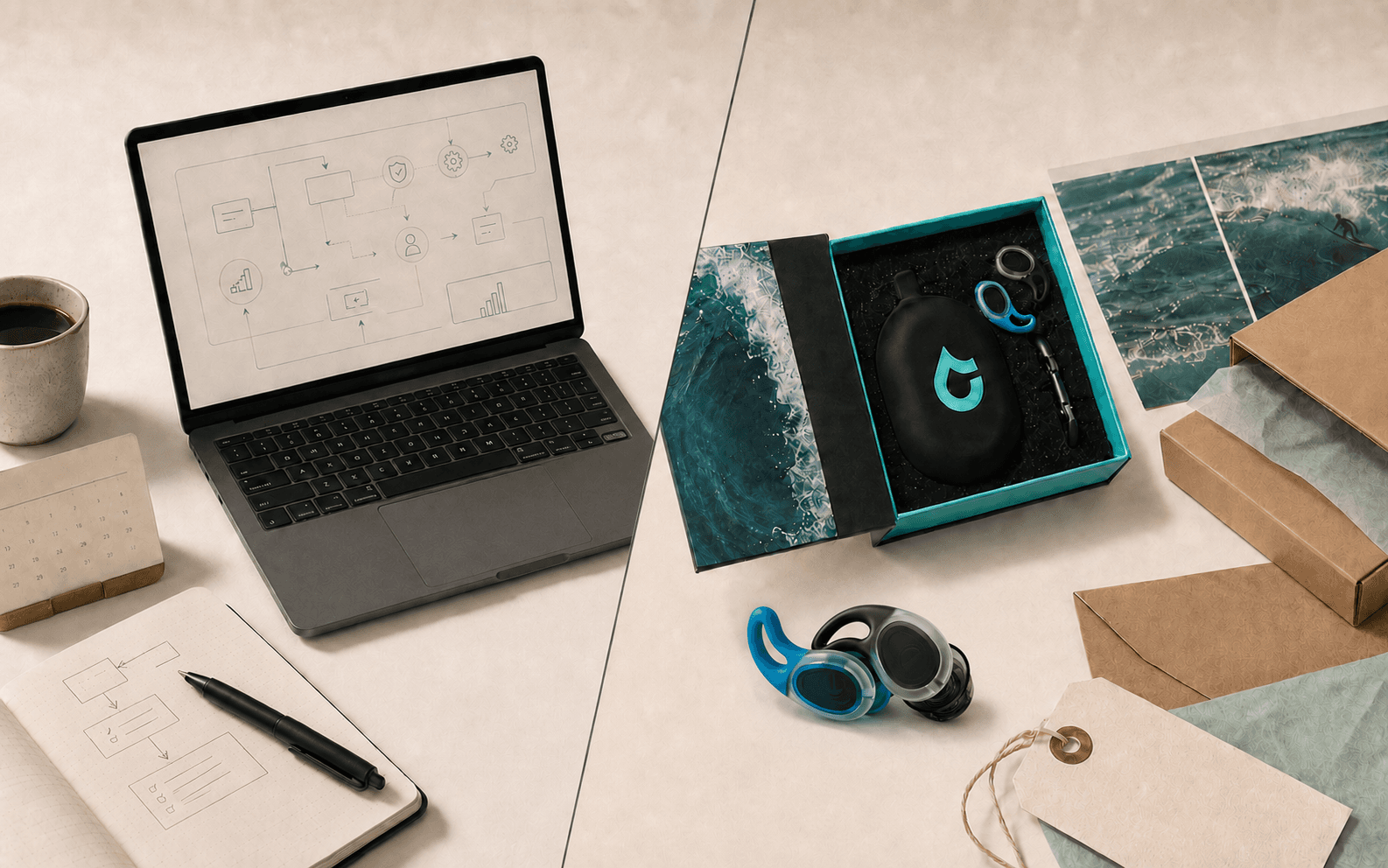
I work full time in AI. Alongside that, I co-run SEAR Plugs, a water-sports earplug brand I founded with my partner Andrea. SEAR gets evenings, weekends, and whatever focus is left after a full working day.
That constraint is the most honest thing about this article. Nothing below comes from a position of unlimited time or a team to delegate to. Every workflow exists because the alternative was the task not getting done at all.
The rule I apply before automating anything
Before I build anything, I ask one question: will this task happen again?
One-off tasks almost never justify automation. The setup cost — writing the prompt properly, testing the output, building the review step — only pays back on repetition. Early on I automated things because it was satisfying, not because it was useful. A few of those systems quietly died within a month. That was a useful lesson: an automation nobody maintains is just a slower way of doing nothing.
The tasks that survived the test are boring, recurring, and structured:
- SEO and keyword research for the SEAR blog
- Drafting and updating product-page copy
- Researching retailers before outreach
- First drafts of responses to customer reviews and support emails
- Competitive and product research
- Internal documentation of our own processes
What an AI-assisted evening actually looks like
Here is a realistic example, not an idealised one.
A blog post for SEAR used to take me a full weekend afternoon: keyword research, reading what already ranks, outlining, drafting, editing, formatting, metadata. Now the research and first draft are AI-assisted and the whole thing fits into an evening. The part I kept for myself is the part that matters: deciding whether the piece says anything true and useful, and rewriting the sections where the draft sounds like everyone else's draft. (For a more practical read on this specific system, see The Two-Tier SEO Content Pipeline.)
That last point deserves emphasis. AI output converges on the average of what exists. For a small brand, sounding average is a slow way to disappear. So the human pass is not proofreading — it is the actual work. The machine compresses the mechanical eighty percent; I spend my saved time on the twenty percent that differentiates us.
Where automation was not worth it
A few honest failures:
Fully automated social content. The drafts were fine, and fine is the problem. Scheduling generic posts is worse than posting nothing, because it teaches your audience that your channel is skippable. We stopped.
Outreach without research. I tested lightly-personalised templated outreach at a small scale. The response quality told me everything. What works is the reverse: use AI to research each retailer deeply — their range, their customers, their gaps — and then write a short, specific message. AI for the research, human for the relationship.
Anything customer-facing without review. Every customer-facing word still gets human eyes before it ships. A support reply that is 95% right and 5% wrong is not 95% useful. The 5% is where you lose a customer.
The uncomfortable accounting
If you want one takeaway, take this: measure the time saved, including the review time.
Some automations look impressive and save nothing, because reviewing and correcting the output takes as long as doing the task. I now think of every workflow as having three costs — setup, execution, and review — and the review cost is the one people forget. If review costs stay high after a few iterations, the workflow is telling you something: either the task needs judgment AI doesn't have, or your prompt is doing too much at once.
Why this works at all
The honest answer is that limited time forces clarity. When you only have two evenings a week for a business, you stop debating and start deciding. Every process gets written down, because I need to hand it to a machine or to Andrea without a meeting. Every task gets triaged: automate it, do it properly, or admit it's not happening.
I don't think of this as a productivity story. It's an ownership story. The systems are what make it possible to build something of our own without giving up careers we chose deliberately. That trade is worth documenting honestly — including the parts that fail.
I'll keep publishing the individual workflows, with what worked and what didn't, in the AI Workflows section.
Field Notes
Get the next article — and the workflows behind it — by email.
Keep reading
AI & automation
Four MCPs Every Small Brand Should Run in Claude
The difference between an AI that gives you advice and one that acts on your real business — the four connectors I run for SEAR Plugs, why each one earns its place, and where each still needs a human hand.
· 9 min read
Career & ownership
Flexibility Is Not the Same as Freedom
Remote work and flexible hours are conditions someone else sets. Freedom is what you own: skills, assets, systems and options. Notes on the difference, from someone building both a career and a company.
· 3 min read